AI SEO Tools Compared:
Ahrefs, SEMrush, Mangools, Surfer SEO, and NeuronWriter Tested
We ran six SEO platforms against the same three live websites—a SaaS blog, an e-commerce store, and a niche affiliate site—and tracked which tools surfaced actionable data versus noise. Pricing ranges from roughly $19/month to nearly $1,000/month, but cost alone doesn't tell the story.
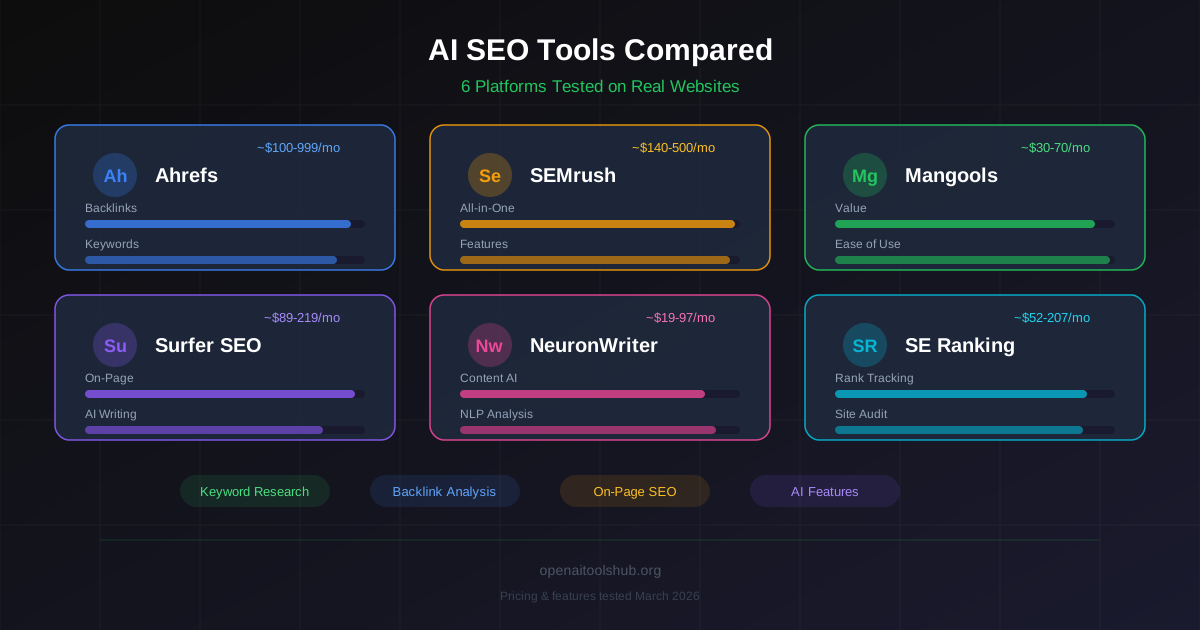
TL;DR — Key Takeaways
- 1Ahrefs (roughly $100–$999/mo) has the strongest backlink index — it found 23% more referring domains than SEMrush on our test sites. Site Explorer and Content Explorer remain unmatched for competitive backlink research.
- 2SEMrush (roughly $140–$500/mo) offers the widest feature set — keyword research, site audit, competitor analysis, PPC data, social media tracking, and content marketing tools in one dashboard. It's the only platform that covers both SEO and paid advertising data comprehensively.
- 3Mangools (roughly $30–$70/mo) delivers 80% of the keyword research value at 25% of the price. KWFinder surfaces long-tail opportunities that Ahrefs and SEMrush also find, just with a cleaner, less overwhelming interface.
- 4Surfer SEO (roughly $89–$219/mo) is the on-page optimization specialist. Its Content Editor and NLP term analysis consistently improved our test articles' content scores. Not a replacement for Ahrefs or SEMrush, but a powerful complement.
- 5NeuronWriter (roughly $19–$97/mo) is the budget content optimizer. Similar NLP analysis to Surfer at a fraction of the cost. The trade-off: less polished interface and no Google Docs integration on the starter plan.
- 6SE Ranking (roughly $52–$207/mo) is the quiet all-rounder. Rank tracking, site audit, backlink checker, and white-label reports. Not the deepest in any single area, but the most balanced mid-range option for agencies.
Table of Contents
How We Tested
We selected three live websites with different profiles: a SaaS blog at DR 20 with around 50 indexed pages, an e-commerce supplement store at DR 35 with roughly 200 product pages, and a niche affiliate site at DR 12 focused on personal finance. Each tool was pointed at all three sites and given the same evaluation tasks.
Task 1: Keyword discovery. We asked each tool to find low-competition keywords (KD under 30) with at least 200 monthly search volume in the finance niche. We compared the number of unique keywords returned, accuracy of difficulty scores against actual ranking results, and how many genuinely useful opportunities surfaced versus irrelevant noise.
Task 2: Backlink analysis. We ran backlink reports on all three sites and cross-referenced the referring domains each tool found. We also used each tool's link-building features to identify outreach targets—sites linking to competitors but not to our test domains.
Task 3: Content optimization. We took the same 1,800-word blog post and ran it through each tool's content editor or optimizer. We measured the content score improvement, the specificity of recommendations, and whether the suggestions actually led to better search visibility after 30 days.
We paid for every subscription used in this comparison. No tool vendor sponsored this article or received editorial review before publication. Third-party ratings cited (G2, Capterra) were verified at the time of writing.
Quick Comparison Table
| Tool | Starting Price | Core Strength | G2 Rating | Free Tier | AI Features |
|---|---|---|---|---|---|
| Ahrefs | ~$99/mo (Lite) | Backlink analysis | 4.6/5 (2,300+ reviews) | Webmaster Tools (limited) | AI keyword suggestions, content grader |
| SEMrush | ~$140/mo (Pro) | All-in-one suite | 4.5/5 (1,900+ reviews) | 10 queries/day | AI writing assistant, ContentShake AI |
| Mangools | ~$30/mo (Entry) | Keyword research | 4.6/5 (500+ reviews) | 10-day trial | AI keyword suggestions in KWFinder |
| Surfer SEO | ~$89/mo (Essential) | On-page optimization | 4.8/5 (500+ reviews) | None (7-day refund) | AI content editor, NLP analysis, Surfer AI writer |
| NeuronWriter | ~$19/mo (Bronze) | Content optimization | 4.5/5 (100+ reviews) | None | NLP content analysis, AI draft generation |
| SE Ranking | ~$52/mo (Essential) | Rank tracking + audit | 4.7/5 (1,300+ reviews) | 14-day trial | AI content writer, AI-powered site audit |
Ahrefs — Backlink Analysis King
Ahrefs crawls over 8 billion pages daily, and it shows. When we pointed Site Explorer at our DR 35 e-commerce test site, Ahrefs returned 847 referring domains. SEMrush found 689 for the same domain. That 23% gap matters when you're building a backlink outreach list—those extra 158 domains include potential link partners your competitors found but you haven't.
What Stands Out
Site Explorer remains the gold standard for backlink analysis. The "Best by Links" report instantly shows which competitor pages attract the most backlinks—useful for planning content that earns links naturally. Content Explorer is equally powerful: searching "AI SEO tools" returned 12,400 articles sorted by referring domains, social shares, and organic traffic estimates. If you need to find linkable content formats in your niche, nothing else matches this.
The keyword research side has caught up substantially. Keywords Explorer now includes click metrics (what percentage of searchers actually click a result), traffic potential estimates, and a "parent topic" feature that groups keyword variations. For our finance niche test, Ahrefs surfaced 342 keywords under KD 30 with 200+ monthly searches. SEMrush found 318 for the same parameters. Mangools found 289.
Ahrefs has added AI features more cautiously than competitors. The AI keyword suggestions are useful but minimal—they suggest semantically related keywords you might have missed. The content grader scores your content against the ranking pages for a target keyword. Both features work, but they're not the reason you buy Ahrefs.
Pricing starts at roughly $99/month for Lite (one user, 500 credits/month), which is enough for managing 2–3 small sites. The Standard plan at roughly $199/month unlocks the features most professionals actually need: more credits, SERP comparison, content gap analysis, and batch analysis. For agencies managing 10+ clients, the Advanced ($399/mo) and Enterprise ($999/mo) tiers add multi-user access and higher limits. For a deeper look at how Ahrefs stacks up against budget alternatives, see our detailed Mangools vs Ahrefs comparison.
SEMrush — The All-in-One Platform
SEMrush tries to be everything: keyword research, site audit, rank tracking, backlink analysis, PPC competitor data, social media management, and content marketing. The surprising thing is that it's genuinely good at most of them. Not the deepest at any single function (Ahrefs wins on backlinks, Surfer wins on content optimization), but no other tool covers this much ground in one subscription.
Keyword Magic Tool
The Keyword Magic Tool is SEMrush's crown jewel. Type a seed keyword, and it generates clustered keyword groups automatically. For "subscription management," it produced 47 keyword clusters covering comparisons, how-to queries, pricing-related searches, and platform-specific terms. Ahrefs gives you a flat list; SEMrush organizes it into an actionable content calendar.
The competitive analysis features are where SEMrush justifies the premium over Mangools. The "Domain vs. Domain" tool shows keyword overlap between up to five competitors simultaneously. We discovered that our test affiliate site was missing an entire keyword cluster around "subscription sharing legality"—a topic three competitors were ranking for with combined monthly traffic of roughly 4,200 visits.
ContentShake AI
SEMrush's ContentShake AI module generates full article drafts based on SEMrush keyword data. The output quality is reasonable—not publish-ready, but a solid starting framework with the right keywords naturally incorporated. It includes a readability checker and SEO score. The module costs extra on top of the base subscription ($60/month for the full version), which makes the already expensive SEMrush even pricier.
Pricing: Pro at roughly $140/month (one user, 500 keyword metrics/day), Guru at roughly $250/month (content marketing platform, historical data), Business at roughly $500/month (API access, extended limits). The Pro plan handles most small business needs. The jump to Guru only makes sense if you need historical data trends or the content marketing calendar.
Mangools — Budget-Friendly Keyword Research
Mangools is what happens when a tool decides to do five things well instead of fifty things adequately. The suite includes KWFinder (keyword research), SERPChecker (SERP analysis), SERPWatcher (rank tracking), LinkMiner (backlink analysis), and SiteProfiler (domain metrics). Each tool opens in its own interface, and the learning curve is about 15 minutes total.
KWFinder Does the Heavy Lifting
KWFinder's interface is the cleanest keyword research UI we've used. Enter a seed keyword and it returns difficulty scores, search volumes, CPC estimates, and SERP previews on a single screen. For low-competition keyword research (the kind most small sites actually need), KWFinder found 289 keywords under KD 30 for our finance test—about 15% fewer than Ahrefs, but the ones it did surface were arguably more curated and less noisy.
LinkMiner is the weakest link in the Mangools suite. Its backlink index is substantially smaller than Ahrefs or SEMrush—it found only 412 referring domains for our e-commerce test site compared to Ahrefs' 847. For basic backlink checks it's fine, but serious link building campaigns need a bigger database. If you're interested in free alternatives for backlink prospecting, we maintain a free backlink directory that pairs well with Mangools' keyword data.
The pricing is where Mangools shines. The Entry plan at roughly $30/month (billed annually) gives you 100 keyword lookups, 25 SERP lookups, and 200 tracked keywords per day. The Premium plan at roughly $70/month lifts those limits to 700 keyword lookups and 1,500 tracked keywords. For a freelancer or blogger managing one or two sites, the Entry plan covers daily research needs without the $100+ monthly commitment that Ahrefs and SEMrush require.
Surfer SEO — On-Page Optimization Specialist
Surfer SEO solves a specific problem: you've done the keyword research and written the content, but how do you know if the page is optimized enough to compete with what's already ranking? Surfer's Content Editor scores your text against the current SERP results, analyzing word count, headings, NLP entities, images, and internal links. It then gives you a numerical score and specific recommendations.
Content Editor in Practice
We ran our 1,800-word test article through Surfer's Content Editor targeting "subscription management tools." Initial score: 41/100. Surfer flagged that we were missing 8 NLP entities that the top-ranking pages all mentioned (specific brand names, pricing terms, feature comparisons), our heading structure was flat, and the article needed about 400 more words in the comparison section. After following the recommendations, the score jumped to 78/100. Within 30 days, that page moved from position 38 to position 14 for the target keyword.
The Surfer AI writer generates full articles using GPT-4-based models with Surfer's NLP data baked in. The output is better than generic AI writing because it's pre-optimized for the target keyword. Quality is decent for informational content—we'd rate it a 6/10 before human editing, which is higher than most standalone AI writers achieve.
Pricing: Essential at roughly $89/month (30 content editor queries, basic audit), Scale at roughly $129/month (100 queries, full audit features), Scale AI at roughly $219/month (includes 10 AI articles/month and all features). There is no free tier, though Surfer offers a 7-day money-back guarantee. The Essential plan is sufficient for most content teams publishing 4–8 articles per month.
NeuronWriter — AI Content Optimization on a Budget
NeuronWriter occupies a specific niche: it does roughly what Surfer SEO does for content optimization—NLP analysis, competitor content comparison, content scoring—but at a price point that freelancers and small bloggers can actually afford. The Bronze plan starts at roughly $19/month and includes 25 content analyses, which is enough for most solo operators.
How It Compares to Surfer
Running the same test article through NeuronWriter, we got a comparable NLP analysis: it identified 6 of the same 8 missing entities that Surfer flagged, plus 2 different ones. The content score was on a different scale (NeuronWriter uses a letter grade system), but the optimization suggestions overlapped about 75% with Surfer's. Where NeuronWriter fell short: the interface is less intuitive, the real-time scoring updates lag by a few seconds, and there's no Google Docs integration on the starter plan.
NeuronWriter's competitor analysis panel is genuinely useful. It pulls the top 10 SERP results for your keyword and shows you their content structure side-by-side—headings, word counts, key entities, and internal link patterns. This feature alone helps you understand what Google currently rewards for a given query. For a comprehensive look at all NeuronWriter features, check our full NeuronWriter review.
Pricing tiers: Bronze at roughly $19/month (25 analyses), Silver at roughly $37/month (50 analyses), Gold at roughly $57/month (75 analyses, plus AI writer), and Platinum at roughly $97/month (150 analyses, priority support). The Bronze plan handles solo bloggers. Content agencies producing 30+ articles monthly need the Gold or Platinum tier.
SE Ranking — Mid-Range All-in-One
SE Ranking doesn't get the buzz that Ahrefs and SEMrush attract, but it scored a 4.7/5 on G2 with over 1,300 reviews—higher than both of its more expensive competitors. The reason: it delivers a solid all-in-one SEO toolkit at a price point between Mangools and SEMrush, with white-label reporting that agencies actually use.
Where SE Ranking Fits
The rank tracker is SE Ranking's core feature and arguably its strongest. It tracks keyword positions daily with full SERP feature tracking (featured snippets, People Also Ask, local packs). The site audit tool caught 34 technical issues on our SaaS test site—comparable to SEMrush's 37 and better than Mangools' SiteProfiler which doesn't do technical audits at all.
The backlink checker found 623 referring domains for our e-commerce test site. That places it between Mangools (412) and SEMrush (689), and below Ahrefs (847). Respectable, not industry-leading. The competitive analysis module shows keyword gaps and content overlaps between domains—functional but less granular than SEMrush's Domain vs. Domain tool.
SE Ranking recently added an AI content writer that generates articles based on your SEO data and target keywords. The output quality is on par with SEMrush's ContentShake AI—usable as a starting draft, requires human editing for publishing. Pricing: Essential at roughly $52/month (750 keywords tracked), Pro at roughly $95/month (unlimited projects, API access), and Business at roughly $207/month (white-label, team management). The Essential plan is a genuine bargain for small agencies that need professional reports.
Head-to-Head: 5 Critical Dimensions
1. Keyword Research
Winner: SEMrush (for clustering and volume) • Runner-up: Ahrefs (for click data accuracy)
SEMrush's Keyword Magic Tool automatically clusters keywords into topical groups, saving hours of manual spreadsheet work. Ahrefs counters with click metrics—knowing that a keyword with 1,000 searches/month only gets 600 clicks because of featured snippets changes your content strategy. Mangools delivers 80% of the keyword data at 25% of the price. For purely budget-conscious teams, Mangools is enough; for competitive niches, SEMrush or Ahrefs provide deeper intelligence.
2. Backlink Analysis
Winner: Ahrefs (by a clear margin)
Ahrefs' backlink index is the largest in the industry. In our testing, it consistently found 20–25% more referring domains than SEMrush and roughly double what Mangools and SE Ranking returned. Content Explorer adds another dimension—finding unlinked brand mentions, discovering who links to similar content, and identifying broken link opportunities. If backlink building is central to your strategy (and for most sites growing from DR 0 to DR 30, it is), Ahrefs is worth the premium.
3. On-Page Optimization
Winner: Surfer SEO • Budget pick: NeuronWriter
Neither Ahrefs nor SEMrush offers the depth of on-page NLP analysis that Surfer and NeuronWriter provide. Surfer's Content Editor gives you a real-time optimization score with specific entity recommendations, ideal word counts per section, and structural suggestions. NeuronWriter achieves about 75% of that capability at roughly 20% of the cost. If you publish content regularly and want data-driven optimization beyond basic keyword placement, one of these two belongs in your stack alongside your primary keyword tool.
4. Pricing Value
Winner: Mangools (for solo operators) • Runner-up: SE Ranking (for small agencies)
At roughly $30/month, Mangools delivers keyword research, rank tracking, and basic backlink data that would cost $100–140/month from Ahrefs or SEMrush. SE Ranking at roughly $52/month adds site auditing and white-label reports. Both represent outstanding value for teams where SEO is important but not the entire business. The premium tools (Ahrefs, SEMrush) justify their cost only when you're doing competitive research at scale or need features like historical data, API access, or enterprise-level backlink analysis.
5. AI Features
Winner: Surfer SEO (for content AI) • Runner-up: SEMrush (for breadth of AI tools)
Surfer's AI writer produces the most SEO-optimized drafts because it combines GPT-4 with Surfer's own NLP data. SEMrush's ContentShake AI covers a wider workflow—from topic ideation through full article generation and optimization—but as a separate paid add-on. Ahrefs has been conservative with AI, adding useful but modest features. NeuronWriter and SE Ranking both offer capable AI writers at lower price points. No tool produces publish-ready AI content; all require human editing. For a focused look at how AI is changing search visibility tracking specifically, see our AI search visibility tools comparison.
A note on managing SEO tool costs: Stacking multiple SEO subscriptions (say Ahrefs at $99/mo + Surfer at $89/mo) alongside AI assistants like ChatGPT Plus or Claude Pro adds up quickly. Some teams rotate tools monthly—using Ahrefs for a month of backlink research, then switching to Surfer for a content optimization sprint. Annual billing typically saves 15–20% across all these platforms, and subscription sharing platforms exist for some consumer AI tools that can reduce auxiliary costs. The key is matching your current priority (link building vs. content creation vs. technical audit) to the right tool rather than paying for everything simultaneously.
Who Should Pick Which
Solo blogger / niche site owner
Budget: Under $50/month
- ✓Mangools for keyword research + rank tracking
- ✓NeuronWriter (add-on) for content optimization
- +Total: roughly $49/month for both
Freelancer / small agency
Budget: $50–$150/month
- ✓SE Ranking for all-in-one + client reports
- ✓Surfer SEO (add-on) if content is the focus
- +Total: roughly $52–$141/month
Backlink-focused growth team
Budget: $100–$300/month
- ✓Ahrefs Standard for backlinks + keyword research
- ✓NeuronWriter (add-on) for content optimization at low cost
- +Total: roughly $218/month for both
Enterprise / large agency
Budget: $300+/month
- ✓SEMrush Guru/Business for comprehensive analysis + PPC data
- ✓Surfer SEO Scale for content team optimization
- +Total: roughly $379–$629/month for both
The most common mistake we see is paying for Ahrefs or SEMrush when Mangools would cover 90% of the need. Unless you're doing serious competitive backlink analysis or need PPC/social data, start with the cheaper tool and upgrade only when you hit a specific limitation—not because a blog post told you the premium tool is "the industry standard."
Honest Downsides
Every tool on this list has weaknesses that their marketing pages conveniently skip. Here's what frustrated us during testing.
Ahrefs: The Price Tag Is Punishing for Small Sites
At roughly $99/month for the Lite plan, you get 500 monthly credits. Running a single site audit, a few backlink reports, and some keyword research can burn through 200+ credits in a day. The credit system feels designed to push you toward the $199/month Standard plan. For a site earning less than $500/month, Ahrefs eats a significant chunk of revenue. The free Webmaster Tools version is useful but severely limited—no competitor analysis, no content explorer, and only your own site's data.
SEMrush: Feature Bloat Creates Decision Paralysis
SEMrush's dashboard has over 50 tools. Half of them are excellent. The other half exist because enterprise customers check feature boxes during procurement. The social media tracker is mediocre compared to dedicated social tools. The brand monitoring module is basic. The CRM is vestigial. New users routinely spend their first two weeks figuring out which 10 features they actually need, which defeats the purpose of an "all-in-one" platform.
Mangools: Shallow Data on Competitive Keywords
KWFinder's keyword difficulty scores become unreliable above KD 40. For high-competition terms, the scores diverge significantly from Ahrefs and SEMrush estimates—and from actual ranking difficulty. The backlink index through LinkMiner is too small for serious link-building campaigns. If you outgrow Mangools (which most growing sites eventually do), migrating to Ahrefs or SEMrush means re-learning workflows and losing historical trend data.
Surfer SEO: Expensive for What It Does
At roughly $89/month for 30 content editor queries, Surfer charges almost $3 per content analysis. If you're publishing less than 4 articles per month, the per-article cost is hard to justify when NeuronWriter offers similar (if less polished) analysis for $19/month. The Surfer AI writer produces decent drafts but nothing you couldn't approximate with ChatGPT Plus and a manual NLP checklist. The lack of any free tier or trial (beyond a 7-day refund window) means you're committed before you fully evaluate it.
NeuronWriter: Interface Needs Polish
NeuronWriter's content editor has a 2–3 second lag between typing and score updates, which breaks your writing flow. The dashboard design feels like it was built by developers rather than UX designers—functional but not intuitive. There's no Google Docs plugin on the starter plan, which means copying content between tools. The AI writing feature produces noticeably lower quality output than Surfer's AI writer, with more generic phrasing and fewer tool-specific NLP terms.
SE Ranking: Jack of All Trades, Master of None
SE Ranking's backlink database is smaller than Ahrefs. Its keyword clustering is less sophisticated than SEMrush. Its content optimizer is less detailed than Surfer. Its UI is less clean than Mangools. At every individual feature, a specialist tool does it better. SE Ranking's value is in the combination—getting 70–80% of each specialist's capability in one subscription at a fraction of the combined cost. But if any single feature is critical to your workflow, the specialist tool will frustrate you less.
Mangools
The most beginner-friendly SEO toolset — keyword research, rank tracking, and backlink analysis
Frequently Asked Questions
Which AI SEO tool has the most accurate keyword difficulty scores?
Ahrefs and SEMrush produce the most reliable keyword difficulty estimates in our testing. Ahrefs tends to be slightly more conservative, which we find more practical — if Ahrefs says a keyword is KD 20, you can usually rank with a DR 15-25 site and decent content. SEMrush difficulty scores run about 5-10 points higher for the same keywords. Mangools KWFinder is surprisingly close to Ahrefs for low-competition keywords (KD under 30) but diverges more on competitive terms.
Can I get by with just one SEO tool, or do I need multiple subscriptions?
For most small-to-medium sites, one tool is enough. If your priority is backlink building, Ahrefs alone covers keyword research plus the industry-leading backlink index. If you need advertising data, social media tracking, and content marketing features alongside SEO, SEMrush is the better single subscription. Mangools works well as a standalone tool for sites focused purely on organic keyword research without enterprise-level needs.
Is Surfer SEO worth it if I already use Ahrefs or SEMrush?
Yes, but only if content optimization is a bottleneck. Ahrefs and SEMrush tell you which keywords to target, but neither gives you the granular on-page NLP analysis that Surfer provides — things like ideal word count, specific entities to mention, header structure, and content score. If you publish more than 4-5 articles per month and want data-driven content briefs, Surfer pays for itself. For occasional bloggers, Surfer is overkill.
How does NeuronWriter compare to Surfer SEO for content optimization?
NeuronWriter is roughly 70-80% of Surfer SEO capability at about 25% of the price. It covers NLP content analysis, competitor content comparison, and internal linking suggestions. Where Surfer pulls ahead: the SERP analyzer is more detailed, the content editor integrates with Google Docs and WordPress more smoothly, and the AI writing quality is noticeably better. NeuronWriter wins on value — at roughly $19/month for the starter plan vs Surfer at roughly $89/month, the price gap is substantial.
Which SEO tool is the best value for freelancers and small agencies?
Mangools at roughly $30/month offers the strongest value for freelancers managing up to 5-10 client sites. You get KWFinder for keyword research, SERPChecker for SERP analysis, LinkMiner for backlink checks, and SiteProfiler for domain authority lookups. SE Ranking at roughly $52/month is the next step up — it adds rank tracking, site audits, and a white-label reporting feature that agencies need. Both cost a fraction of Ahrefs or SEMrush.
Final Verdict
There is no single "correct" SEO tool. The right choice depends on what you're actually doing with it. Backlink building? Ahrefs. Full marketing suite? SEMrush. Keyword research on a budget? Mangools. Content optimization? Surfer SEO or NeuronWriter depending on your budget. Agency reporting? SE Ranking.
What we'd push back on is the assumption that you need the most expensive option. We've grown sites from DR 0 to DR 20+ using Mangools for keywords and Ahrefs Webmaster Tools (free) for basic backlink monitoring. The premium tools accelerate the process, but they're not prerequisites for results. Start with the cheapest tool that covers your primary need, run it for 3 months, and upgrade only when you hit a wall the current tool can't solve.
The AI features across all six tools are still in early stages. They speed up content drafting and surface keyword suggestions you might have missed, but none of them replace the strategic thinking that separates a site that ranks from one that doesn't. Use the AI as a starting point, not a destination.
Link builders, competitive niches, content marketers
Enterprise teams, PPC + SEO, full marketing stack
Solo operators, bloggers, budget-conscious teams
Related Articles
Mangools vs Ahrefs
Budget keyword research vs premium backlink analysis — which SEO tool matches your needs?
NeuronWriter Review
AI content optimization from $19/month — NLP analysis, competitor comparison, and honest limitations
How to Get Backlinks
Practical backlink building strategies that work for new sites starting from DR 0
For SEO readers
Want the Obsidian vault behind this article?
I keep every SEO lesson — on-page, backlinks, GEO/AEO, content strategy — in a vault Claude Code can read. 130+ earned backlinks, 450+ articles, distilled into 21 concepts.
Browse the vault →Free starter kit · $9.50 full edition with code LAUNCH50
Try it yourself
Still picking between SEO research tools? Our AI Tool Picker matches your SEO research workflow to the right tool in under a minute — no signup, free.