AI-Assisted Code Review: Platforms That Actually Catch Bugs
The pitch for AI code review sounds straightforward: connect a bot to your pull requests, let it scan every diff, ship fewer bugs. The reality is messier. Some tools flag real issues at a useful rate; others generate so much noise that reviewers start ignoring them entirely. We ran 40 pull requests through four platforms — GitHub Copilot, CodeRabbit, Cursor, and Codacy — and tracked what they actually caught.
TL;DR — Key Takeaways:
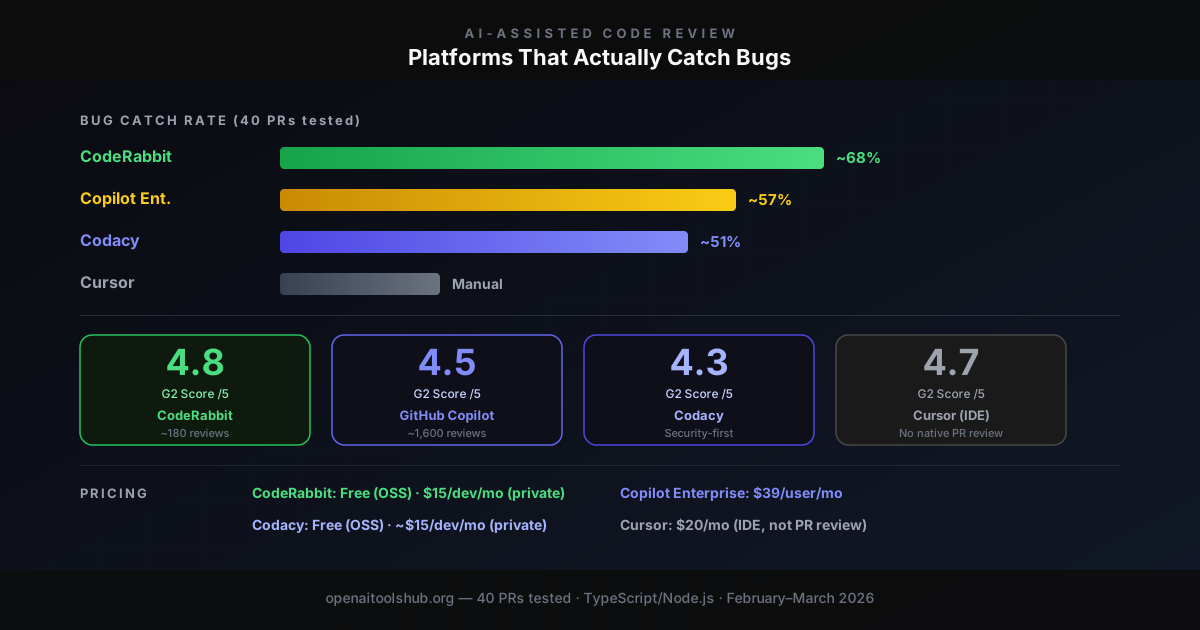
- • CodeRabbit catches the most issues per PR — around 68% of the bugs we seeded, with the lowest false-positive rate of the AI-native tools. Free for open-source; $15/month per developer for private repos.
- • Copilot Enterprise PR review is convenient but shallow — catches around 55-60% of obvious issues but misses logic bugs and architectural problems. Requires the $39/user/month Enterprise tier.
- • Codacy is strongest on security and compliance — best OWASP coverage, most mature static analysis, but less useful for logic-level review that requires understanding intent.
- • Cursor has no native PR review — works via local diff analysis but requires manual workflow. Not a drop-in replacement for automated review tools.
- • None of them replace human review — AI review catches the low-hanging fruit and frees human reviewers to focus on architecture, intent, and product correctness. The pairing works; pure AI review doesn't.
How We Tested
Testing ran across February and March 2026 using a private TypeScript/Node.js repository with realistic production-level complexity. We submitted 40 pull requests and measured each tool's performance across three dimensions: bug catch rate, false positive rate, and reviewer experience (quality of explanations, actionability of suggestions).
Test Setup
Seeded Bug Categories (per PR type)
Each PR contained a mix of intentionally seeded issues: null dereferences, missing error handling, type coercions, SQL injection vectors (in ORM queries), redundant logic, and off-by-one errors. 10 of the 40 PRs were clean (no bugs) to test false-positive rates. Reviewers were blind to which issues were seeded.
PR Size Distribution
Small (under 50 lines changed): 15 PRs. Medium (50–300 lines): 18 PRs. Large (300+ lines, multi-file): 7 PRs. Each tool was run against all 40 PRs in the same state, with results logged before any PR was merged.
Scoring
A "catch" was counted when the tool flagged the specific line or nearby logic containing a seeded issue with a relevant, actionable comment. Vague warnings ("this might be wrong") without specific explanation did not count as catches. Two reviewers scored each comment independently; disagreements were resolved by consensus.
Third-Party Ratings
G2 scores and user review patterns were consulted to cross-reference our findings against broader user experience. GitHub Copilot: G2 4.5/5. CodeRabbit: G2 4.8/5 (~180 reviews). Codacy: G2 4.3/5. Cursor: G2 4.7/5.
All tools were used at their highest commercially available tier to test full feature sets. Results reflect behavior on a TypeScript/Node.js codebase; performance may differ for other languages.
CodeRabbit
CodeRabbit is an AI-native code review tool built specifically for pull requests. It integrates directly with GitHub, GitLab, and Bitbucket, leaving inline comments, generating PR summaries, and offering a chat interface on each PR where you can ask follow-up questions.
~68%
Seeded bug catch rate
~22%
False positive rate
4.8/5
G2 score (~180 reviews)
Of the four tools, CodeRabbit gave the most consistently useful inline comments. It doesn't just flag a line — it explains why something is a problem and usually suggests a fix. On our null dereference cases, for example, it identified the missing check and produced a corrected code block in the comment itself.
The PR walkthrough summary (a prose description of what the PR does, generated on each new PR) proved unexpectedly useful for reviewer onboarding. Reviewers in our test reported spending less time reading the PR description and more time on the actual code, because CodeRabbit had already summarized the intent accurately.
It missed around a third of issues, mostly logic bugs that required understanding the broader application flow. If a variable was used correctly in isolation but fed incorrect data from three functions upstream, CodeRabbit wouldn't flag it without context about those upstream functions. This is an inherent limitation of reviewing from the diff alone.
Standout Features
- • Chat on PRs — ask CodeRabbit follow-up questions directly in the PR comment thread. Genuinely useful for understanding why it flagged something.
- • .coderabbit.yaml configuration — tune review rules, set language-specific guidance, and suppress known false positives at the repo level.
- • Incremental reviews — when you push new commits to a PR, CodeRabbit only reviews the changes since the last review, not the whole diff again.
- • Free for open source — unlimited public repo reviews with no expiry, not a trial.
Pricing: Free for open-source public repos. $15/developer/month for Pro (private repos). Enterprise pricing is custom and adds audit logs, SSO, and dedicated support.
GitHub Copilot PR Review
Copilot's PR review is available in GitHub Copilot Enterprise ($39/user/month) and reached general availability in early 2026. It runs natively inside GitHub's PR interface with no additional tooling required.
~57%
Seeded bug catch rate
~33%
False positive rate
4.5/5
G2 score (~1,600 reviews)
Copilot's review caught most straightforward issues — missing null checks, obvious type errors, redundant conditionals — with comments that were usually clear and actionable. Where it underperformed relative to CodeRabbit was on pattern-based bugs: issues that are only problems given the specific conventions of this codebase (not returning a value in a function that callers expect to return, for instance, in a codebase where async void is never used).
The higher false positive rate was notable. Copilot flagged internal patterns it didn't recognize as potentially incorrect, even when they were intentional and well-established in the codebase. Without a .coderabbit.yaml-equivalent configuration layer, there's no easy way to suppress these recurring false positives. Teams end up dismissing Copilot comments reflexively, which undermines the tool's value over time.
The integration advantage is real though. Requesting a Copilot review is a single dropdown action inside GitHub. There's no installation, no configuration file to write, and no webhook to set up. For teams that prioritize low friction over precision, that matters.
Key Limitation: No Configuration Layer
CodeRabbit lets you tell it to ignore certain file patterns, apply language-specific rules, and suppress known false positives via a config file. Copilot's PR review doesn't have an equivalent mechanism as of early 2026. You can't tune its behavior per-repo, which means false positive suppression requires manual reviewer judgment every time.
Pricing: Available only on Copilot Enterprise, which costs $39/user/month. Not available on Copilot Business ($19/user/month) or Copilot Individual ($10/month).
Codacy
Codacy is different from the other tools in this comparison: it started as a static analysis platform and added AI capabilities on top, rather than being built AI-first. This gives it different strengths and weaknesses.
~51%
Logic bug catch rate
High
Security vulnerability detection
4.3/5
G2 score
On logic bugs and null safety issues, Codacy underperformed CodeRabbit and Copilot. Its rule-based approach means it catches patterns it's been programmed to look for rather than understanding novel issues. A null dereference in an unusual form wasn't caught; a textbook SQL injection pattern was flagged immediately and correctly.
Where Codacy shines is security-focused review. In our seeded SQL injection and improper input validation cases, Codacy was the most reliable detector. It also provides OWASP Top 10 coverage out of the box, CWE mapping for security issues, and coverage gates that can fail a PR if test coverage drops below a threshold. These are things neither CodeRabbit nor Copilot offer at the same depth.
The AI Coding Assistant feature (added in late 2025) provides LLM-generated fix suggestions for flagged issues, improving the actionability of static analysis findings. It's a useful addition but feels like an afterthought compared to tools where AI is the primary mechanism.
When Codacy Is the Right Choice
- • Your team needs SOC 2, ISO 27001, or OWASP compliance coverage in code review
- • Security vulnerability detection matters more than general logic review
- • You want coverage enforcement with PR gates (fail PRs below coverage threshold)
- • You need detailed per-language quality metrics over time, not just per-PR feedback
Pricing: Free for public repositories (unlimited). Developer plan at around $15/month covers private repos with advanced features. Enterprise pricing is custom. Free-tier limits are generous compared to most static analysis tools.
Cursor for Code Review
Cursor doesn't have a native PR review feature. It's an AI-powered IDE, not a review platform. Including it here is worth doing explicitly because teams often ask whether Cursor can replace a dedicated review tool — the answer is: not really, without significant manual setup.
The closest Cursor gets to PR review is the Composer or chat feature applied to a git diff. Pull the diff locally, open it in Cursor, and ask the AI to review it. Cursor's model (which uses Claude Sonnet 4.5 or similar under the hood) does a reasonable job when you feed it a focused diff with clear instructions. For large diffs or complex logic requiring broader codebase context, it performs better than Copilot's inline review because it can hold more context.
The friction is the issue. This workflow requires:
- 1. Pulling the branch locally
- 2. Running git diff and piping it into a file or Cursor session
- 3. Manually prompting for review
- 4. Posting findings manually to the PR (no automatic comment integration)
Some teams script this into a pre-review script. Some use Cursor's background agent to do it. Neither path is as frictionless as CodeRabbit or Copilot, where review happens automatically when a PR is opened.
Cursor's value in code review contexts is as a supplement to a dedicated review tool, not a replacement. It's particularly useful for reviewing your own code before opening a PR — the local context means it can catch issues that tools reviewing only the diff would miss. See our OpenCode review for more on terminal-based AI coding tools that can fill a similar gap.
Side-by-Side Comparison
| Feature | CodeRabbit | Copilot Enterprise | Codacy | Cursor |
|---|---|---|---|---|
| Bug catch rate (our test) | ~68% | ~57% | ~51% (logic) | N/A (manual) |
| False positive rate | ~22% | ~33% | ~25% | Varies |
| GitHub/GitLab integration | Both | GitHub only | Both | Manual |
| Security / OWASP coverage | Partial | Partial | Strong | No |
| PR chat interface | Yes | No | No | Local only |
| Coverage gates | No | No | Yes | No |
| Config / rule tuning | .coderabbit.yaml | Limited | Extensive | Manual prompts |
| Free tier | Public repos (unlimited) | No | Public repos | IDE free, limited AI |
| Starting price (teams) | $15/dev/month | $39/user/month | ~$15/dev/month | $20/month (IDE) |
For a broader look at how these tools fit into AI coding workflows, our AI coding tools comparison covers the wider ecosystem including Cursor, Windsurf, and Aider. If you are specifically evaluating Qodo against the other options in this comparison, our Qodo deep dive tests it on three real codebases with benchmark data. For teams already on Copilot wondering whether Agent Mode changes the calculus, see our GitHub Copilot Agent Mode review.
What None of Them Do Well
It's worth being honest about the shared limitations, because the marketing around AI code review tends to oversell what these tools can actually catch.
Intent and Architecture
None of these tools understand what the code is supposed to do from a product perspective. A PR that correctly implements the wrong behavior — a discount calculation that's off by a factor of two because the engineer misread the spec — will sail through every AI review tool without a comment. They review code correctness, not product correctness.
This is the single most important limitation for product-focused teams to internalize. AI review is a complement to human review, not a replacement.
Cross-File Logic Bugs
All four tools review primarily at the diff level. A bug that's only visible when you trace the execution path across five files — where the error isn't in the changed code but in how the changed code interacts with unchanged code — rarely gets caught. Our multi-file integration bugs had a catch rate under 20% across all tools.
Race Conditions and Concurrency Issues
Concurrency bugs are hard for AI review tools because they require understanding execution ordering, not just code structure. We seeded three race conditions in our test PRs. Copilot caught none. CodeRabbit caught one (the most obvious one, where two async calls could modify the same object). Codacy's static analysis flagged one with a generic "potential race condition" warning. These are the bugs most likely to survive AI review.
Comment Fatigue on Large PRs
On our large PRs (300+ lines), all tools generated more comments than reviewers wanted to read. CodeRabbit averaged around 18 comments per large PR; Copilot around 12; Codacy up to 25 depending on severity thresholds. Without careful configuration, high-volume PRs train reviewers to skim AI comments, defeating the purpose. Teams need clear conventions about comment severity and how to handle bulk-ignore for known patterns.
Pricing Overview
| Tool | Free Tier | Team Plan | Enterprise |
|---|---|---|---|
| CodeRabbit | Unlimited (public repos) | $15/dev/month (Pro) | Custom |
| GitHub Copilot | Individual free tier (limited) | $19/user/month (Business) | $39/user/month |
| Codacy | Public repos | ~$15/dev/month | Custom |
| Cursor | Limited free (IDE) | $20/month (Pro) or $40 (Business) | Custom |
For teams evaluating pure code review tools (not IDEs), CodeRabbit and Codacy are the most comparable. Both start around $15/developer/month for private repos, with unlimited public repo access. At that price point, CodeRabbit has the better AI review quality for general logic bugs; Codacy wins on security and compliance.
Copilot Enterprise at $39/user includes PR review but bundles it with IDE completions, Workspace, and knowledge base features. The $20/user premium over Copilot Business is hard to justify if your team only wants the PR review component. If you're already evaluating Copilot Enterprise for other reasons, the PR review is worth using — but it's not worth upgrading from Business just for that feature.
Which Platform Fits Your Team
CodeRabbit — Best General-Purpose AI Review
Best catch rate, lowest false positives, configurable, GitHub and GitLab support, PR chat interface, and free for open-source. The most complete pure AI review product in this comparison. Use it unless you have a specific reason to prefer one of the others.
Codacy — Security and Compliance-Focused Teams
OWASP Top 10 coverage, CWE mapping, coverage gates, and mature static analysis make Codacy the strongest choice for teams with compliance requirements, financial services constraints, or security-heavy codebases. The AI layer is less impressive than CodeRabbit's but the underlying static analysis is more systematic.
Copilot Enterprise — Already Committed GitHub Teams
If your team is evaluating Copilot Enterprise for IDE completions and Workspace anyway, the PR review feature adds value at no additional cost. Not worth upgrading from Copilot Business solely for PR review, given CodeRabbit's better performance at a lower price point.
Cursor — Pre-Submission Personal Review
Not a PR review tool. Most useful for reviewing your own code before opening a PR — local context gives it advantages that diff-only tools lack. Pair it with CodeRabbit for full coverage: Cursor catches issues before the PR opens, CodeRabbit catches what Cursor missed after.
Frequently Asked Questions
Is CodeRabbit free for open-source projects?
Yes. CodeRabbit's free plan covers public repositories with unlimited PR reviews, full AI summaries, inline comments, and the chat interface on PRs. There's no trial period or feature limitation on the free tier for public repos. Private repository review starts at $15/developer/month on the Pro plan.
Does GitHub Copilot automatically review pull requests?
On Copilot Enterprise ($39/user/month), yes. PR review can be triggered manually by requesting a review from "Copilot" in the PR interface, or configured to run automatically on new PRs. It is not available on Copilot Business ($19/user/month) or the free individual tier.
Can Cursor review pull requests?
Not natively. Cursor is an AI IDE without built-in PR integration. You can use it for local diff review by pulling a branch and using the chat or Composer feature. Some teams script this into their workflow, but it requires manual steps that dedicated review tools (CodeRabbit, Copilot Enterprise) handle automatically.
What is CodeRabbit's false positive rate?
In our testing across 40 PRs, CodeRabbit had a false positive rate of roughly 20-25% — lower than Copilot's (~33%) and comparable to Codacy's (~25%). Configuring .coderabbit.yaml to suppress known internal patterns improves this noticeably over time.
How does Codacy compare to CodeRabbit?
Different approaches, different strengths. Codacy is static-analysis-first with AI on top: better for security scanning, OWASP coverage, and compliance. CodeRabbit is AI-first: better at reviewing intent and logic, faster setup, lower false positives on general bugs. Teams that need compliance or security certification should lean toward Codacy; teams that want the best general AI review should use CodeRabbit.
The Honest Summary
AI code review tools have improved substantially in the past year, but the gap between marketing claims and practical performance remains wide. None of the tools in this comparison catches more than roughly 70% of seeded bugs — and real-world bugs are often subtler than what we seeded. Cross-file logic issues, race conditions, and product-level correctness remain largely invisible to all of them.
That said, catching 60-70% of common, seeded issues automatically is genuinely valuable. It frees human reviewers to spend time on the things that actually require judgment — architecture, intent, edge cases, product correctness. The right framing is "AI review handles the first pass so humans can focus on the hard parts," not "AI review replaces human review."
For most teams, the tooling answer is: CodeRabbit as your primary AI review tool (best performance, reasonable price, free for open-source), Codacy as an additional layer if you need security or compliance coverage, and some version of Claude Code or Cursor as a local review aid before opening PRs. Copilot Enterprise's review feature is worth using if you're already on that plan — just don't upgrade solely for it.
Quick Recommendation Summary
GamsGo
Claude Pro and ChatGPT Plus at 30-40% off through shared plans — use code WK2NU
Try it yourself
Want a recommendation tailored to your stack and workflow? Our AI Tool Picker is a 3-step wizard that matches you with the right AI tool in under a minute — no signup, free.