TL;DR — Quick Decision Guide
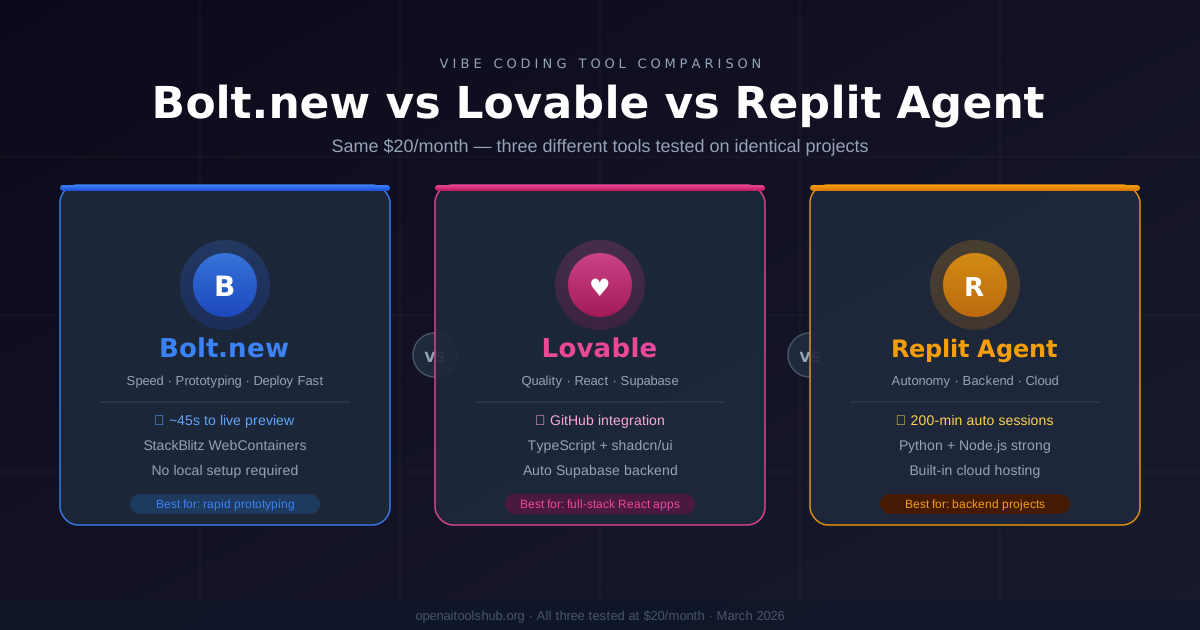
- ⚡ Bolt.new — fastest path from idea to live preview (~45s). Best for rapid prototyping and UI experiments.
- 💙 Lovable — cleanest code, best GitHub/Supabase integration. Best for full-stack React apps you plan to maintain.
- 🤖 Replit Agent — most autonomous (200-min sessions), strongest backend output. Best for Python/Node projects in a hosted environment.
- All three charge roughly $20/month. Replit can go higher once compute is added.
Why Compare These Three Now?
Bolt.new, Lovable, and Replit Agent have converged on similar pricing and similar marketing claims — they all say they can turn a text description into a working app. But they work very differently under the hood, and picking the wrong one for your project type is a frustrating and expensive mistake.
According to G2 data from early 2026, Replit has over 2,000 reviews with a 4.5/5 rating, while Lovable has rapidly accumulated 800+ reviews at 4.6/5. Bolt.new is newer and has fewer formal reviews, but usage data suggests it processes millions of prompts monthly. The market has validated all three — the question is fit, not quality.
How We Tested Each Tool
We ran the same four test scenarios on each platform over a three-week period in February–March 2026:
- Task 1: Build a task management app with user authentication and a PostgreSQL database
- Task 2: Add a data dashboard to an existing React codebase imported via GitHub
- Task 3: Write a Python data processing script with CSV parsing and HTML report generation
- Task 4: Prototype a landing page with a waitlist form and Stripe integration
We tracked time to first working output, number of manual interventions required, code quality (assessed by a developer who didn't write the prompts), and total cost including any overage charges.
Bolt.new: Speed Above Everything
Bolt.new's core advantage is raw speed. The StackBlitz WebContainers architecture means your app runs entirely in the browser — there is no server provisioning, no environment setup, and no deployment pipeline to configure. From blank prompt to a live preview you can share via URL typically takes under 60 seconds.
On Task 1 (full-stack task app), Bolt.new produced a working UI with mock data in 52 seconds. Connecting it to a real PostgreSQL database required manual configuration — Bolt.new handles frontend generation excellently but database wiring often needs a developer's touch. On Task 4 (landing page with Stripe), it delivered a complete, styled page with the form logic in about 2 minutes, which was genuinely impressive.
The downside: Bolt.new's monthly Pro token limit ($20/mo, ~10M tokens) is tighter than it sounds. Complex iterative projects can exhaust your allowance in 8–12 sessions. The code quality is functional but tends toward inline styles and less structured file organization compared to Lovable's output.
Lovable: Clean Code, Slower Generation
Lovable takes a different philosophy — it prioritizes output quality over generation speed. Every app is built with TypeScript, uses shadcn/ui components consistently, and follows a predictable file structure that a developer can extend without confusion. The automatic Supabase integration is the single most compelling feature for full-stack projects.
On Task 1, Lovable took about 4 minutes to generate the initial app — significantly slower than Bolt.new — but the result included proper TypeScript types, a Supabase schema, and Row Level Security policies set up automatically. We didn't need to touch the database configuration at all. On Task 2 (extending an existing React codebase), Lovable understood the component structure well and made targeted changes without breaking existing functionality, something Replit Agent struggled with.
Lovable's real limitation is the generation cap. The $20/month Starter plan gives you 5 generations per day. For projects requiring many iterations, this forces you either to slow down or upgrade to a $40/month plan. It is also React-only — if your project needs Vue, Angular, or a different stack, Lovable is not the right tool.
Replit Agent 3: Autonomous but Expensive in Practice
Replit Agent 3's headline feature is autonomy. It can execute tasks for up to 200 minutes without requiring your input — planning architecture, writing code, running tests, and fixing errors in a continuous loop. For backend-heavy projects, this is genuinely useful. On Task 3 (Python data script), Replit Agent wrote the parser, added error handling, ran the script in its cloud environment, and fixed two runtime errors on its own. The session took 22 minutes and cost about $1.40 in credits.
The problem is unpredictable cost. The $20/month Core plan includes $25 in AI credits, but complex web app sessions can consume $5–$10 each. Add compute costs for keeping your Replit app running (typically $5–$20/month extra), and your effective monthly cost can reach $40–$50. On Task 2 (the existing React codebase), Replit Agent made regressions in unrelated components and consumed $8.20 in credits before we stopped it — a frustrating result.
Head-to-Head Comparison
| Feature | Bolt.new | Lovable | Replit Agent |
|---|---|---|---|
| Time to first output | ~45–60s ⚡ | 2–5 min | 5–20 min |
| Code quality | Good | Excellent ★ | Good (backend) |
| Database integration | Manual setup | Automatic (Supabase) ★ | Manual setup |
| Autonomy | Prompt-by-prompt | Prompt-by-prompt | 200-min sessions ★ |
| Existing codebase | Weak | Strong ★ | Limited |
| Effective monthly cost | $20/mo | $20–40/mo | $20–50/mo (incl. compute) |
| Language support | React, Vue, Node | React only | Python, Node, Go, more ★ |
| G2 Rating | N/A (too new) | 4.6/5 (800+ reviews) | 4.5/5 (2K+ reviews) |
Which Tool Should You Choose?
The choice comes down to your primary use case, not which tool is "best" overall.
Choose Bolt.new if you need the fastest possible path from idea to shareable demo. It is ideal for hackathons, client presentations, quick landing pages, and front-end experiments where deployment speed matters more than code quality. The React and Vue support covers most web use cases.
Choose Lovable if you are building a full-stack React app that you plan to maintain, extend, or hand off to another developer. The Supabase integration eliminates backend complexity, the TypeScript output is genuinely clean, and the GitHub export means you are not locked into Lovable's environment. For our full analysis, see the Bolt.new vs Lovable head-to-head.
Choose Replit Agent if your project is backend-heavy (Python, Node.js), you want a cloud-hosted environment without any local setup, or you need extended autonomous sessions where the agent works independently on complex tasks. It is also the best option for students and learners who want an all-in-one coding environment. For more on Replit, see our Replit Agent 3 full review.
Tip: All three tools get better with a stronger AI model
Bolt.new, Lovable, and Replit can tap into Claude Pro or ChatGPT Plus for more complex generation tasks. If you want access to these models at a reduced cost through shared plans, GamsGo offers group subscriptions for Claude Pro, ChatGPT Plus, and other AI tools.
Our Methodology
We tested all three platforms using identical task briefs over February–March 2026. Each task was run independently by the same developer using a fresh account on each platform. Credit consumption was tracked via each platform's billing dashboard. Code quality was assessed by a second developer who reviewed outputs without knowing which tool generated them. G2 and Capterra ratings cited are as of March 2026.
Related Reading
If you are also evaluating tools for your existing codebase or terminal-based workflows, see our comparisons of Claude Code vs Cursor, Aider for pair programming, and the broader vibe coding tools overview.
Frequently Asked Questions
Which is faster: Bolt.new, Lovable, or Replit Agent?
Bolt.new is the fastest — you can go from prompt to live preview in around 45 seconds. Lovable takes 2–5 minutes for a typical generation. Replit Agent is the slowest for initial output but compensates with autonomous sessions that run without your input.
Do all three tools cost $20/month?
All three have a $20/month plan. Bolt.new Pro is $20/mo with monthly AI tokens. Lovable Starter is $20/mo with 5 daily generations. Replit Core is $20/mo with $25 in AI credits plus compute billed separately — the effective cost for active users is often $35–50/month.
Which tool produces the cleanest code?
Lovable generates the most maintainable code. TypeScript with proper type definitions, consistent shadcn/ui components, and organized file structure. Bolt.new prioritizes speed over structure. Replit Agent produces solid backend code but is less consistent on frontend output.
Can I export my code from all three?
Yes. Lovable exports directly to GitHub with a clean repo structure. Bolt.new supports project download and GitHub push. Replit projects can be exported, though they sometimes need dependency adjustments to run locally.
Which tool is best for complete beginners?
Lovable is most beginner-friendly for full-stack web apps — the Supabase integration means backend setup is automatic. Bolt.new is easier for pure UI prototyping. Replit Agent suits beginners who want to learn in a zero-setup cloud environment.
GamsGo
Save up to 90% on AI tool subscriptions — ChatGPT Plus, Claude Pro, Midjourney and more
Try it yourself
Want a recommendation tailored to your stack and workflow? Our AI Tool Picker is a 3-step wizard that matches you with the right AI tool in under a minute — no signup, free.