Codex vs Claude Code —
Cloud Parallel Agent vs Local Terminal, Which Actually Ships Faster
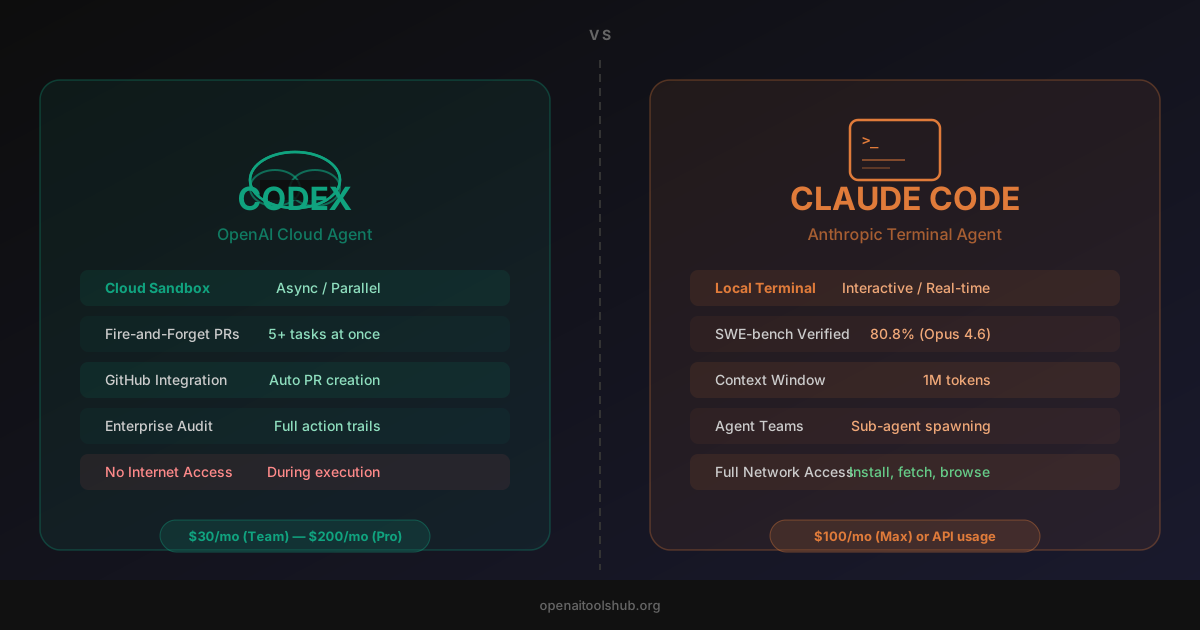
OpenAI's Codex is a cloud-based coding agent that runs tasks asynchronously in sandboxed containers. Anthropic's Claude Code is a local terminal agent powered by Opus 4.6. One lets you fire off five tasks and close your laptop. The other gives you real-time control over every file change. We tested both on real codebases to see which workflow actually ships code faster. For standalone deep-dives, see our OpenAI Codex review and Claude Code multi-agent tutorial.
Key Takeaways:
- • Codex excels at parallel async workflows — submit 5 tasks, close your laptop, come back to 5 PRs ready for review. No local setup, no terminal babysitting
- • Claude Code wins on code quality and interactive control — 80.8% SWE-bench Verified, 1M token context window, real-time feedback loop with your codebase
- • Codex is slow for small changes — container spin-up adds 30-90 seconds overhead. Not worth it for a quick bug fix
- • Codex has no internet access during execution — cannot fetch packages, call APIs, or browse docs while running. Claude Code has full network access locally
- • Pricing: Codex = ChatGPT Pro $200/mo or Team $30/mo; Claude Code = Max $100/mo or API usage — for heavy use, Claude Code on API billing often costs less
How We Tested
We ran both tools against a production Next.js monorepo (~180 files, ~45k lines) and a Python backend (~90 files, ~22k lines) over two weeks. Tasks included bug fixes, test generation, multi-file refactoring, dependency upgrades, and documentation updates. We measured wall-clock time, PR acceptance rate, and how many manual corrections each tool needed before merge.
- • Bug fixes: 12 real issues from our backlog — ranging from one-liner typos to cross-file logic errors
- • Test generation: 8 modules with zero test coverage — unit tests + integration tests
- • Refactoring: 6 multi-file refactors — extracting components, renaming across 15+ files, migrating API patterns
- • Parallel batch: 5 independent tasks queued simultaneously on Codex vs sequentially on Claude Code
- • Third-party data: SWE-bench Verified scores, community reports from r/ChatGPTPro and r/ClaudeAI, Artificial Analysis benchmarks
What Is OpenAI Codex
Codex is OpenAI's cloud-based coding agent, launched in early 2026. Unlike inline code completers like Copilot, Codex operates as an autonomous agent. You describe a task in natural language, it clones your GitHub repo into an isolated cloud sandbox, writes the code, runs tests, and creates a pull request — all without touching your local machine.
The “fire-and-forget” model is the headline feature. You can submit five separate tasks — add error handling to the payment module, write tests for the auth service, update the API docs, refactor the database layer, fix that CSS overflow bug — and walk away. Codex processes them in parallel across separate containers. When you come back, five PRs are waiting for review.
Under the hood, Codex is powered by a codex-1 model (related to the o3/o4-mini reasoning family). It includes built-in safeguards: it can read and write files, run shell commands within the sandbox, execute tests, and lint code. Enterprise customers get full audit trails of every action the agent took. The model runs inside a hardened container that gets destroyed after each task.
What Is Claude Code
Claude Code is Anthropic's terminal-based coding agent. It runs directly on your machine, inside your existing development environment. No cloud containers, no sandboxing — it has full access to your filesystem, your git history, your running processes, and your network. It reads your codebase, proposes changes, and applies them with your approval.
Powered by Claude Opus 4.6 with a 1 million token context window, Claude Code holds significantly more code context in memory than any competing tool. On SWE-bench Verified — the standard benchmark for autonomous code agents — it scores 80.8%, currently the highest published result. For a deeper look at how it handles large refactoring jobs, see our Claude Code multi-file refactoring deep dive.
The interactive model is the core difference. Instead of submitting a task and waiting for a PR, you work alongside Claude Code in real time. It reads a file, asks clarifying questions, proposes a change, you approve or redirect, it applies the edit and moves to the next file. You see every change as it happens. Agent Teams — a feature that lets Claude Code spawn sub-agents for parallel subtasks — adds some async capability, but the primary workflow remains hands-on. For a comparison with another popular tool, see our Claude Code vs Cursor comparison.
Head-to-Head: 10 Dimensions
| Dimension | Codex (OpenAI) | Claude Code (Anthropic) |
|---|---|---|
| Execution Model | Cloud sandbox (async) | Local terminal (interactive) |
| Underlying Model | codex-1 (o3/o4-mini family) | Claude Opus 4.6 |
| SWE-bench Verified | Not officially published | 80.8% |
| Context Window | Full repo cloned per task | 1M tokens (~3M lines) |
| Parallel Tasks | Native (5+ simultaneous) | Agent Teams (sub-agents) |
| Internet Access | None during execution | Full local network |
| Git Integration | Auto PR creation (GitHub) | Full git access (any remote) |
| Setup Required | None (cloud) | npm install + API key |
| Enterprise Audit | Full action trails | Local logs only |
| Price (Monthly) | $30/user (Team) or $200 (Pro) | $100 (Max) or API usage |
Parallel Workflow Management: Where Codex Wins
Codex's strongest advantage has nothing to do with code quality. It's workflow throughput. We queued five independent tasks on a Monday morning: generate unit tests for the auth module, add input validation to three API endpoints, update README documentation, fix a date formatting bug, and refactor a utility file. Total wall-clock time from submission to five PRs ready for review: 23 minutes. We were making coffee during most of it.
Running those same five tasks sequentially through Claude Code took about 48 minutes of active terminal time. Claude Code produced slightly cleaner code on three of the five tasks — more idiomatic error handling, better variable names — but the time difference was stark. For teams with large backlogs of well-defined tasks, Codex's parallel execution is genuinely useful.
The pattern that works with Codex: batch together tasks that are independent, well-scoped, and don't require external dependencies. Test generation is the sweet spot. Documentation updates are solid. Routine refactoring works if the scope is clear. Where it breaks down: anything that needs human judgment mid-task, requires installing new packages, or depends on the output of another task.
The honest assessment: Codex's edge is project management, not code intelligence. It ships more PRs per hour because it runs more tasks simultaneously — not because each individual output is superior.
Interactive Coding: Where Claude Code Wins
Claude Code's real-time feedback loop is hard to appreciate until you've used it on a gnarly bug. We had a race condition in a WebSocket handler that only manifested under concurrent connections. With Claude Code, the debugging session went like this: it read the handler, identified two suspicious state mutations, asked whether we used Redis pub/sub (we did), then traced the exact interleaving that caused the bug. Total time: 7 minutes. Interactive clarification made this possible.
We tried the same bug on Codex. It identified the file correctly, proposed a fix that addressed one of the two race conditions, but missed the Redis timing issue entirely. The PR needed manual correction. Without the ability to ask follow-up questions during execution, Codex had to guess at the architecture — and guessed wrong on a detail that mattered.
The 1M token context window is the other differentiator. On our 45k-line Next.js monorepo, Claude Code loaded roughly 180 files into context simultaneously. It could trace a function call from a React component through three layers of API middleware to a Prisma query without losing track. Codex clones the full repo but processes it through a smaller effective context, which means it occasionally misses cross-file dependencies that span more than a few hops. For how Claude Code handles these large refactors specifically, our AI coding tools guide covers the broader landscape.
Pricing Breakdown
Cost structures are different enough that your usage pattern determines which is cheaper:
Codex (OpenAI)
- • ChatGPT Pro: $200/month (higher task limits)
- • ChatGPT Team: $30/user/month (lower quotas)
- • No per-task billing
- • Enterprise: custom pricing + audit trails
Claude Code (Anthropic)
- • Claude Max: $100/month (heavy usage)
- • API billing: ~$15/M input, ~$75/M output tokens
- • Light users often spend $30-50/month on API
- • No minimum commitment
For a solo developer running 5-10 tasks per day, Claude Code on API billing typically costs $40-80/month. Codex on ChatGPT Team is a flat $30 but with lower task limits that might not cover heavy usage. ChatGPT Pro at $200 gives unlimited Codex access but is hard to justify unless you're running 20+ tasks daily.
For teams, the math shifts. Five developers on ChatGPT Team is $150/month total for parallel cloud agents with audit trails. Five developers each using Claude Code Max is $500/month. The team scenario clearly favors Codex on price — if the task volume justifies the subscription.
Real Downsides You Should Know
Codex Weaknesses
- • Container spin-up latency — 30-90 seconds before any code runs. Kills small-task efficiency
- • No internet during execution — cannot install packages, call APIs, or reference live docs
- • No mid-task corrections — if it misunderstands the task, you get a wrong PR and start over
- • GitHub only — no GitLab, Bitbucket, or self-hosted repo support yet
- • Mixed code quality reviews — community consensus is “hard to say it's dramatically better” than alternatives on raw output quality
- • Opaque reasoning — you see the PR diff but not the agent's decision process. Hard to debug why it made specific choices
Claude Code Weaknesses
- • Requires active attention — you need to be at the terminal approving changes. No fire-and-forget
- • Local resource consumption — API calls from your machine, network bandwidth for large contexts
- • No built-in PR creation — it edits files and commits, but you push and create PRs yourself
- • Token costs can spike — a complex refactoring session with Opus 4.6 can burn $5-10 in a single conversation
- • Setup friction — needs Node.js, npm install, API key configuration. Not zero-effort
- • Context drift on long sessions — past the 800K token mark, earlier instructions can get deprioritized
Neither tool is a clear winner across all scenarios. Codex optimizes for throughput at the cost of precision and flexibility. Claude Code optimizes for precision at the cost of throughput and attention. The “which is better” question is really “which trade-off matches your workflow.”
For an alternative approach that sits between these two models, the open-source OpenCode project offers a terminal agent with broader model support. And for developers who prefer IDE integration over terminal or cloud agents, our Qwen code review covers another option worth considering.
Our Verdict
Use Codex when you have a backlog of well-defined, independent tasks and want to parallelize them without sitting at a terminal. Test generation, documentation updates, routine refactoring, and boilerplate creation are its sweet spot. The fire-and-forget model genuinely saves time if your tasks are scoped tightly enough that the agent won't need human judgment mid-execution.
Use Claude Code when you need precision on complex problems — debugging race conditions, refactoring tightly coupled modules, or working with large codebases where cross-file context matters. The interactive loop catches mistakes that async agents miss, and the 1M token window means it can hold your entire project in memory.
Use both if your budget allows. Queue batch tasks on Codex while working through a tricky refactor with Claude Code in your terminal. That's the workflow that actually maximizes throughput without sacrificing quality on the work that matters. For a model-level comparison of the reasoning engines behind these tools, see our Claude Opus vs GPT Codex breakdown.
NeuronWriter
Writing developer tool comparisons? Score your articles against top Google results before publishing — NLP optimization with real SERP data
Frequently Asked Questions
Is Codex the same as GitHub Copilot?▼
No. Codex is OpenAI's cloud-based coding agent that runs asynchronous tasks in sandboxed containers and produces pull requests. Copilot is GitHub's inline code completion tool integrated into VS Code and other editors. They use different models and serve different workflows — Codex handles multi-file autonomous tasks while Copilot provides line-by-line suggestions as you type.
Can I use Codex and Claude Code together?▼
Yes, and many developers do. A practical pattern is using Codex for batch tasks you can fire off and walk away from (test generation, documentation updates, routine migrations) while keeping Claude Code open in your terminal for interactive work that needs real-time feedback. The tools complement rather than replace each other since they run in completely different environments.
Which tool produces higher quality code?▼
Claude Code currently leads on benchmarks — 80.8% on SWE-bench Verified with Opus 4.6 versus mixed community reports for Codex. In practice, code quality differences are modest for straightforward tasks. The real gap appears in complex refactoring where Claude Code's 1M token context window and interactive correction loop give it an edge over Codex's sandboxed one-shot execution.
Does Codex work with private repositories?▼
Yes. Codex integrates directly with GitHub and can access your private repos. It clones the repository into an isolated cloud sandbox for each task, so your code never persists on OpenAI's servers after the task completes. Enterprise audit trails track every action. Claude Code also works with private repos since it runs locally on your machine — your code never leaves your environment at all.
How much does each tool cost per month?▼
Codex is included with ChatGPT Pro ($200/month) with higher limits, or available on ChatGPT Team ($30/user/month) with lower quotas. Claude Code costs $100/month via Claude Max for heavy usage, or you can pay per API token on the Anthropic API (roughly $15/million input tokens for Opus). For light usage, Claude Code on API billing often costs under $50/month. Codex has no per-task billing — it's bundled into the subscription.
Can Codex access the internet during task execution?▼
No. Codex runs in isolated sandboxes with no internet access during execution. It can only work with the code already in your repository and pre-installed dependencies. This means it cannot fetch external APIs, download packages not in your lock file, or reference live documentation. Claude Code runs locally with full network access, so it can install packages, hit APIs, and browse docs during execution.
Which tool is faster for small bug fixes?▼
Claude Code is significantly faster for small fixes. It starts executing within seconds in your terminal. Codex needs to spin up a cloud container, clone your repo, and set up the environment — which adds 30-90 seconds of overhead before any code runs. For a 2-minute fix, that overhead is painful. Codex's speed advantage only appears when you queue multiple large tasks in parallel.
Do these tools support languages other than JavaScript and Python?▼
Both tools support virtually any programming language. Claude Code works with whatever's in your local environment — Rust, Go, Java, C++, Ruby, or anything else you have installed. Codex supports any language available in its cloud sandbox, though its pre-configured environments are optimized for Python, JavaScript/TypeScript, and Go. Community reports suggest both tools produce stronger results for Python and TypeScript than for less common languages.
Try it yourself
Want a recommendation tailored to your stack and workflow? Our AI Tool Picker is a 3-step wizard that matches you with the right AI tool in under a minute — no signup, free.